

Why Balanced Nutrition for Athletes Supports Performance, Recovery and Resilience
Balanced nutrition is not found in rigid diet protocols – it’s a foundational daily practice that supports everything from how you train and compete to the quality of your work and life.
High standards in the gym, on the field, in class or the boardroom aren’t built on occasional superfoods and a reliance on energy-boosting supplements; they’re built on nutritional consistency and the quality of what you put into your body.
We all know food is fuel, but are you filling up with the right kind to support all-day energy, optimal recovery, and a resilient immune system?
Whether you’re chasing a new PB or powering through a week of back-to-back meetings and multiple deadlines, what you eat provides the biological information your body needs to thrive.
The protein foundation
If you want to move better and stay strong, protein is the one non-negotiable at every meal – it’s the golden standard in every nutrition plan that holds everything together.
While carbs and fats are optional at certain mealtimes, protein is the foundation, providing the building blocks your body needs for muscle repair and growth.
While the basic RDA is 0.8 grams per kilogram per day (g/kg/day), that is the baseline standard for sedentary individuals.
For those living an active lifestyle, the science is clear: aim for 1.6-2.2g/kg/day¹,². A meta-analysis from McMaster University¹ suggests 1.6g/kg/day is the “sweet spot” for muscle development.
To hit this daily target, aim for roughly 0.4g/kg of protein per meal across at least four meals³, prioritising whole foods like lean meats, poultry, fish, eggs, dairy products, and plant-based powerhouse sources, such as quinoa, hemp seeds, and legumes.
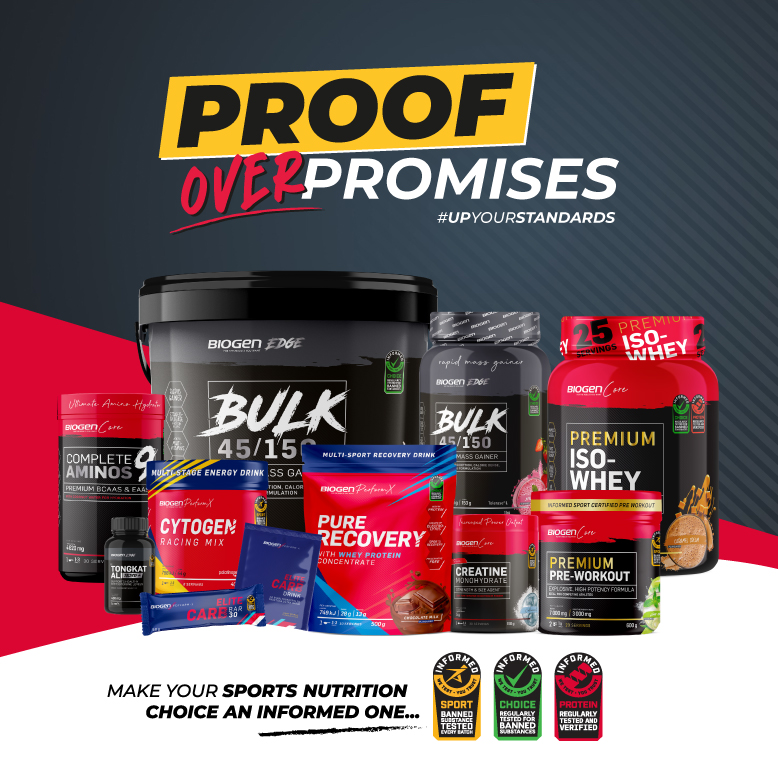
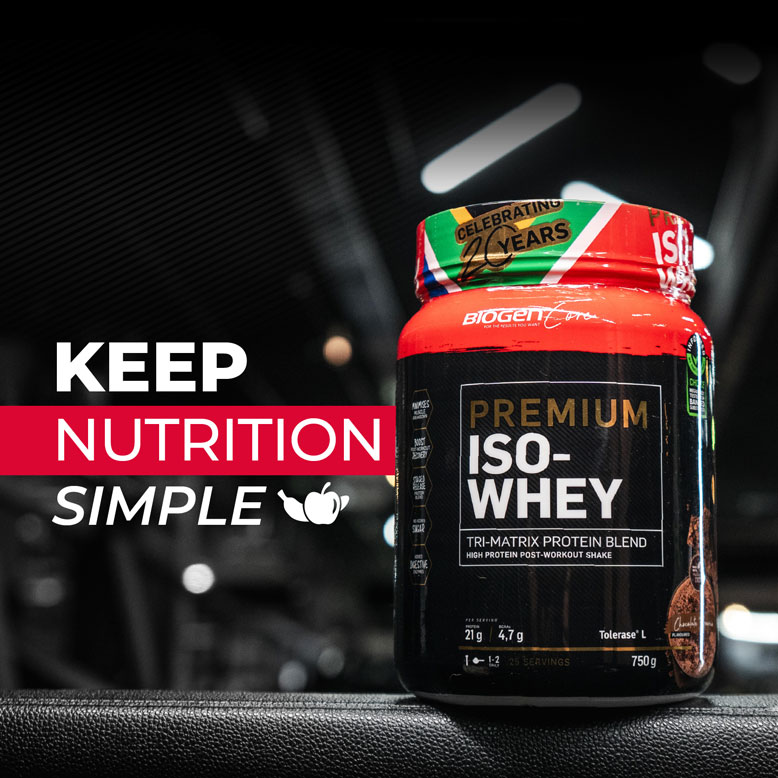
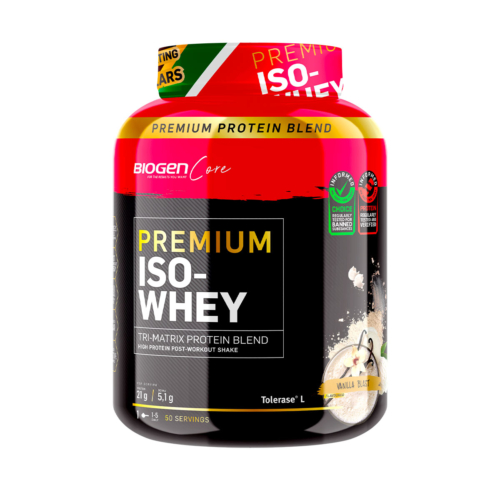
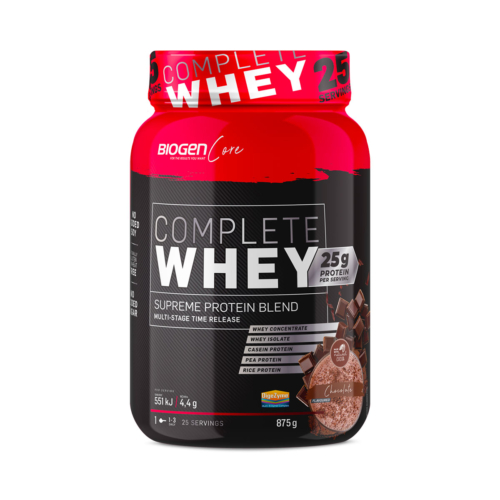
A supplement, like Biogen Iso-Whey or Biogen Complete Whey, provides a convenient and effective source to consistently meet your daily protein needs and hit these targets.
Finding balance
But it’s not just protein that matters. Your body also needs the right carbohydrates and fats to support various processes, including muscle repair, hormonal balance, and energy production.
When it comes to sustained energy, it isn’t about eating more; it’s about making smarter choices.
Your body converts carbohydrates into glucose to fuel everything from your muscles during your morning workout to your brain as your power towards that afternoon work deadline.
However, the timing and type of carbohydrate make all the difference:
A smart nutritional strategy is saving simple carbs for before or during exercise when your body needs immediate fuel. For the rest of the day, stick to complex, whole-food sources to keep your energy stable.
Healthy, natural fats should make up about 20% of your total calories. They are also a source of sustained energy throughout the day and during low-intensity, longer-duration exercise sessions.
Importantly, certain fats are essential for hormone production, including testosterone, which is the driver behind muscle growth and recovery.
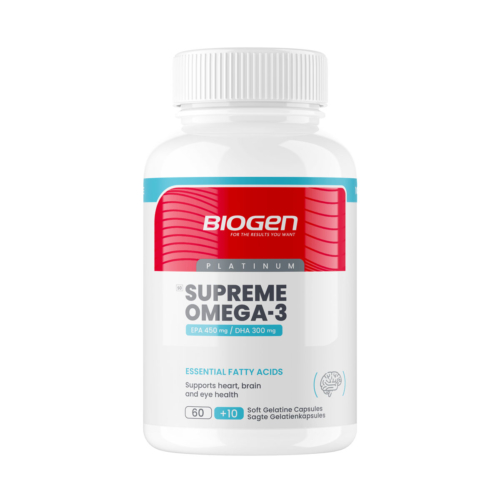
Focus on avocados, walnuts, chia seeds, and fatty fish like salmon or mackerel, with an essential fatty acid supplement, like Biogen Supreme Omega 3, offering added support for heart, nervous system and eye health.
Fortifying your system
While the proteins, carbs, fats we eat every day provide the macronutrients we need for energy, repair and growth, the micronutrients contained in these foods in the form of vitamins and minerals are also critical to overall health and normal bodily functions.
Eating a range of natural foods, such as vegetables, fruit, grains, meat and dairy, nourishes the body. Meeting our required nutritional needs every day is essential for health and wellness, especially regarding digestion, immune function, and stress resilience.
Whole foods provide a range of phytonutrients, vitamins, minerals, fatty acids, fibre and protein to support our bodies. These include antioxidants, like beta-carotene, vitamin C, and vitamin E, which neutralise the free radicals caused by stress, pollution, and intense training⁴, and magnesium – involved in over 300 biochemical reactions – helps muscles relax, supports sleep quality, and activates immune cells.
When it comes to optimal immune function, minerals like zinc and selenium are important because your infection-fighting cells can’t function properly without them⁵.
You can find zinc in oysters, red meat, poultry, beans, nuts, seafood, whole grains, fortified cereals, and dairy products, while selenium is found in Brazil nuts, tuna, beef, poultry, fortified breads and other grain products.
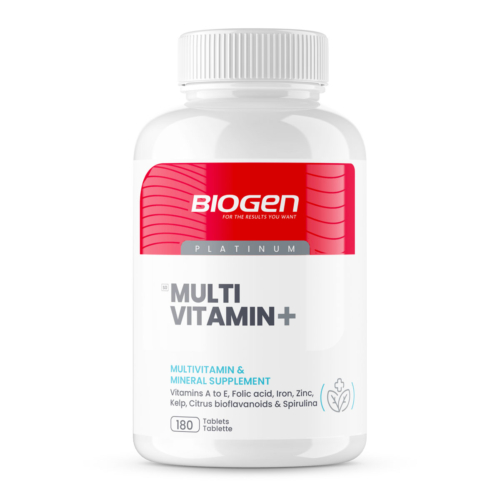
A comprehensive multivitamin, like Biogen Multi Vitamin+, is a high-potency supplement, formulated to provide important vitamin and mineral that the average person struggles to obtain from their diet alone, or to meet the additional needs among hard training athletes.
Consistency counts
While individual choices may seem important when it comes to constructing your diet, remember that one salad won’t make you healthy any more than one doughnut will make you overweight.
Long-term results depend on what you do most days; it’s the protocol you follow 90% of the time that counts.
By consistently choosing high-quality foods at most meals in the week, and supporting your diet with the strategic use of supplements, you’re not just eating, you’re investing in your future self to improve how you train, compete, work and live.
Common questions about balanced nutrition for athletes
REFERENCES:
- Morton RW, Murphy KT, McKellar SR, et al. A systematic review, meta-analysis and meta-regression of the effect of protein supplementation on resistance training-induced gains in muscle mass and strength in healthy adults. Br J Sports Med 2018;52:376–84.doi:10.1136/bjsports-017-097608.
- Arash Bandegan, Glenda Courtney-Martin, Mahroukh Rafii, Paul B Pencharz, Peter WR Lemon, Indicator Amino Acid–Derived Estimate of Dietary Protein Requirement for Male Bodybuilders on a Nontraining Day Is Several-Fold Greater than the Current Recommended Dietary Allowance12, The Journal of Nutrition, Volume 147, Issue 5, 2017, Pages 850-857, ISSN 0022-3166, https://doi.org/10.3945/jn.116.236331.
- Schoenfeld BJ, Aragon AA. How much protein can the body use in a single meal for muscle-building? Implications for daily protein distribution. J Int Soc Sports Nutr. 2018 Feb 27;15:10. doi: 10.1186/s12970-018-0215-1. PMID: 29497353; PMCID: PMC5828430.
- Brambilla D, Mancuso C, Scuderi MR, et al. The role of antioxidant supplement in immune system, neoplastic, and neurodegenerative disorders: a point of view for an assessment of the risk/benefit profile. Nutr J. 2008 Sep 30;7:29. doi: 10.1186/1475-2891-7-29. PMID: 18826565; PMCID: PMC2572622.
- Mocchegiani E, Malavolta M. Role of Zinc and Selenium in Oxidative Stress and Immunosenescence: Implications for Healthy Aging and Longevity. Handbook of Immunosenescence. 2019 Apr 11:2539–73. doi: 10.1007/978-3-319-99375-1_66. PMCID: PMC7121636.